Caitlin Clark Puts An End To The “Men In Women’s Sports” Debate With Blunt Comment About Playing Against a Male [VIDEO]

Caitlin Clark has never been short on confidence when she steps onto a basketball court, but she also has no interest in pretending she could dominate every possible opponent.
The Indiana Fever guard recently gave a surprisingly blunt answer when asked how she might perform in a one-on-one game against an NBA player.
Rather than naming a male player she believed she could beat, Clark immediately dismissed the idea.
“I would get killed by every NBA player,” she said with a laugh.
Clark was then asked which player she would choose if she could face anyone from the NBA. Her answer was Golden State Warriors superstar Stephen Curry.
The response quickly spread across social media, where fans often debate how elite women’s basketball players would perform against male college or professional athletes.
Clark did not attempt to turn the question into a serious challenge or suggest that her accomplishments in the WNBA meant she could overcome the physical advantages of an NBA player in a one-on-one setting.
Instead, she gave a realistic answer and chose one of the greatest shooters in basketball history as her dream opponent.
The hypothetical matchup was never likely to happen outside an exhibition or All-Star event.
The NBA and WNBA are separate leagues, and direct competition between their players is generally limited to special shooting contests, charity events and casual offseason workouts.
That has not stopped fans from constantly creating imaginary matchups.
Clark’s name appears in many of those conversations because of her shooting range, passing ability and enormous influence on women’s basketball. She has built a reputation for taking shots from well beyond the three-point line and creating scoring opportunities that few other guards can see.
Still, one-on-one basketball depends on more than shooting skill.
Size, strength, speed and defensive recovery all become especially important when there are no teammates available to provide screens, help defense or passing options. NBA players would generally hold major physical advantages in those areas.
Clark appeared fully aware of that reality.
Her answer was not an insult to her own ability or to the WNBA. It was simply an acknowledgment that succeeding against women at the highest professional level does not automatically mean she would defeat male NBA players in an individual matchup.
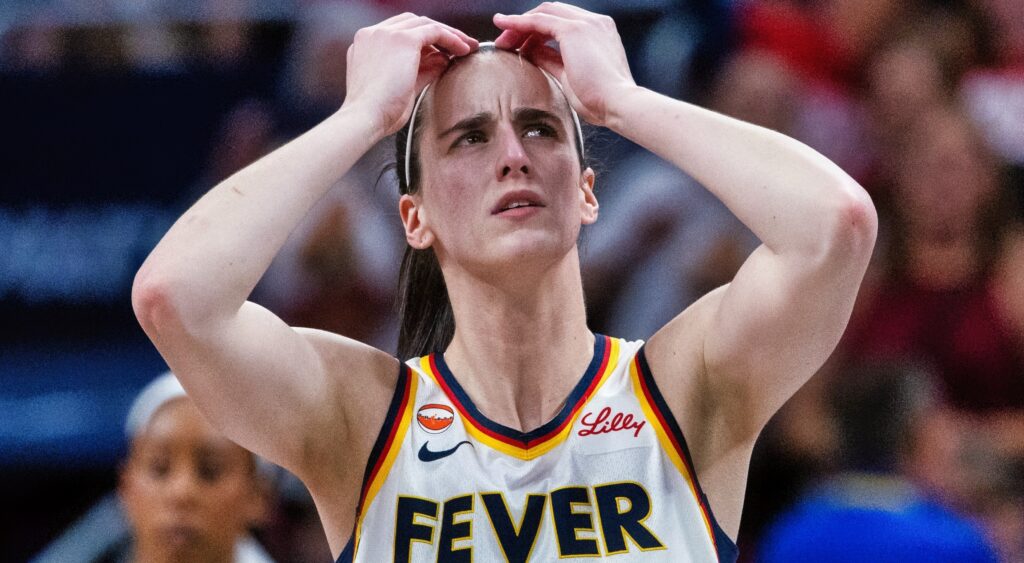
Photo credit: Imagn Images
Choosing Curry also made sense given the similarities people often point out between their games.
Both players are known for extending the range of what is considered a reasonable shot. Defenders must begin guarding them far from the basket, creating more space for teammates and changing the way opposing teams organize their defense.
Clark has frequently been compared with Curry because of her willingness to shoot from the logo and her ability to make difficult three-pointers look routine.
However, she did not claim she could beat him.
Facing Curry would be more about the experience of competing against a player whose shooting helped reshape modern basketball.
Clark’s response also showed the difference between confidence and unrealistic boasting.
She has every reason to believe in her talent. Since entering the WNBA, she has broken league and franchise records while becoming one of the most closely watched athletes in American sports.
At the same time, she was comfortable admitting that an NBA player would have a significant advantage over her in a one-on-one game.
That honesty may be one reason the clip attracted so much attention.
Online sports discussions often reward the loudest or most exaggerated claim. Athletes are encouraged to say they could beat anyone, even when the matchup being discussed makes little practical sense.
Clark chose not to play along.
She laughed, admitted what she believed would happen and then named the opponent she would most enjoy facing.
Caitlin Clark Continues To Rewrite The WNBA Record Book
Clark’s realistic answer should not distract from what she has already accomplished against WNBA competition.
The Fever star became the first player in league history to record at least 40 points and 10 assists in the same game.
Her career-high 45-point performance also established a new Indiana Fever single-game scoring record.
Clark became the only player in WNBA history to score at least 40 points while playing fewer than 30 minutes. That achievement highlighted how quickly she can take control of a game when her outside shot is falling.
She has also continued making an impact as a passer.
Clark recorded the fourth triple-double of her career, matching the league record for the most triple-doubles by a guard.
Her ability to score, rebound and create opportunities for teammates has made her much more than a long-range shooting specialist.
She also became the fastest player in WNBA history to reach 200 career three-pointers, accomplishing the milestone in only 74 games.
In addition, Clark holds the league record for the most career games with at least 20 points and 10 assists.
Those numbers explain why she is regularly included in ambitious hypothetical matchups.
Fans have watched her break records, take over games and make shots that would be difficult for almost any player. It is natural for some viewers to wonder how far those skills might carry her against different levels of competition.
Clark’s answer drew a clear line between appreciating her talent and ignoring the realities of the matchup.

Photo credit: Imagn Images
The viral clip has also been connected to broader arguments about men competing in women’s sports.
However, Clark was not directly discussing league eligibility rules or offering a detailed opinion about transgender athletes.
She was answering a much narrower question about how she personally would perform against an NBA player in a one-on-one game.
Her response was straightforward: she believed every NBA player would beat her.
That distinction matters because a short quote can easily be pulled into a much larger political or cultural argument that the athlete was not actually addressing.
Clark did not claim that her answer settled every debate involving men’s and women’s sports. She simply acknowledged the physical difference she would expect to encounter against professional male basketball players.
Her comment also did nothing to diminish the level of competition in the WNBA.
Clark competes against the best women’s basketball players in the world, and her record-breaking performances have made her one of the league’s biggest stars.
Admitting that NBA players would defeat her one-on-one does not erase any of those achievements.
It may actually make her answer more credible.
Clark understands what she does well, but she also recognizes that confidence does not require pretending obvious differences do not exist.
She could have used the moment to make a bold claim and generate an even louder headline.
Instead, she laughed at the premise, admitted she would probably have a very difficult night and selected Stephen Curry as the player she would most like to face.
For an athlete whose every comment can become a national conversation, it was a remarkably uncomplicated answer.
Caitlin Clark knows she is one of the best players in the WNBA.
She also knows that challenging an NBA star one-on-one would be an entirely different problem.