Angel Reese’s ‘Black Barbie’ Comments Quickly Backfire As Fans Expose Her False Doll Claims [VIDEO]
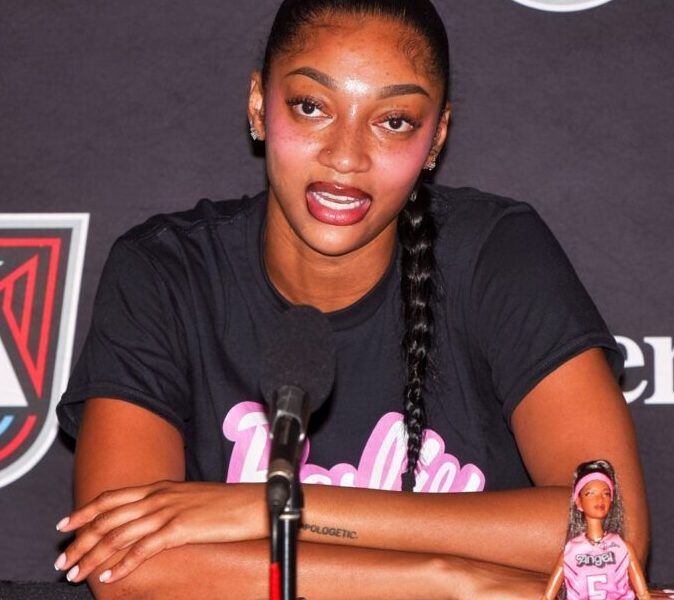
Angel Reese’s latest milestone with Mattel should have been a straightforward celebration. Instead, comments she made while discussing her official Barbie doll quickly pulled the Chicago Sky star into another heated online debate.
Reese recently unveiled a Barbie created in her likeness, joining a growing list of athletes and public figures honoured by the iconic toy company. The release was widely celebrated by supporters who viewed it as another sign of her influence beyond basketball.
The conversation changed, however, after Reese explained why the collaboration felt personally meaningful.
During an interview about the doll, she said she did not really play with dolls while growing up because they did not look like her. Reese then suggested that young Black girls now have access to something she did not have as a child.
Her point appeared to focus on representation and the importance of children seeing themselves reflected in popular toys. Many viewers understood what she was trying to say, particularly when considering how often white dolls have dominated store shelves and advertising.
Others took her words much more literally.
Within hours, social media users began pointing out that Black Barbie dolls existed long before Reese was born. Several accused her of overlooking decades of Mattel history and presenting her own release as though it were the first time Black children had been represented by the brand.
Mattel introduced the first Black doll officially named Barbie in 1980. The doll was designed by Kitty Black Perkins and marked an important moment for the company because she was the first Black character to carry the Barbie name itself.
Mattel had introduced Black characters before that release.
Christie debuted in 1968 as one of Barbie’s friends. The company later continued expanding its range with more dolls representing different backgrounds, professions and appearances.
Since the release of Black Barbie in 1980, Mattel has produced many more Black dolls through collections such as Fashionistas, collector editions, career ranges and celebrity collaborations.
That history quickly became the centre of the reaction to Reese’s interview.
One commenter said they were eight years older than Reese and remembered growing up with both Black Barbie and Black Bratz dolls. The same person acknowledged that fewer Black dolls were available compared with white ones, but argued that it was inaccurate to suggest they did not exist at all.
The commenter also recalled owning a Black Cabbage Patch Kid, using that example to challenge the idea that children from earlier generations had no dolls resembling them.
Another user wrote that Black Barbie dolls had been released many years before Reese was born and criticised what they saw as an exaggerated claim.
Other reactions were less thoughtful and simply mocked Reese for appearing not to know the history of the brand.
Some users focused on her suggestion that children now had “one” Black Barbie, joking that she seemed to be presenting herself as the first example.

Not everyone involved in the discussion completely rejected Reese’s broader point.
Even several critics agreed that Black dolls were historically less common, received less promotion and were sometimes more difficult to find than white dolls. Their objection was mainly directed at how Reese phrased her experience.
There is an important difference between saying representation was limited and saying it did not exist.
Reese may have been describing her own childhood and what she personally saw in stores or received at home. Her comments did not necessarily amount to a detailed claim about every doll Mattel had ever produced.
However, the wording left enough room for viewers to interpret it as a statement about the entire history of Barbie.
Once that happened, the release itself was pushed into the background while people argued over whether Reese had misunderstood the brand’s past.
The controversy is especially unfortunate because her Barbie still represents a significant career achievement.
The doll recognises Reese as one of the WNBA’s most visible stars and reflects the public profile she has built both on and off the court. Her influence now extends into fashion, entertainment and brand partnerships, giving young basketball fans another athlete to see represented in a major toy line.
CBS News Atlanta described Reese’s “ATL Barbie” as a cultural milestone, noting that supporters viewed the collaboration as recognition of her growing impact beyond sports.
That significance does not disappear simply because Black Barbie dolls came before it.
Reese’s release joins an existing history rather than beginning one. It gives a new generation of fans a doll based on a current WNBA player whose career they can follow in real time.
For young supporters who admire Reese specifically, an earlier Black Barbie or another character may not carry the same personal connection.
The backlash therefore centres less on whether her doll matters and more on how she explained why it matters.
The episode also shows how quickly a promotional interview can become a fact-checking battle online.
Reese was speaking about representation and her own childhood experience. Social media users responded with release dates, older doll collections and personal memories intended to prove that Black children had access to similar toys decades earlier.
Both points can exist at the same time.
Black Barbie dolls were available before Reese was born, beginning officially with the 1980 release. At the same time, the range and visibility of Black dolls were not always equal to those of white dolls, and individual children may still have grown up feeling underrepresented.
Reese’s wording gave critics an opening, but the historical correction does not make her collaboration meaningless.
Her Barbie is not the first Black doll produced by Mattel. It is, however, another high-profile addition to that long history and a reflection of the place she now holds in women’s basketball and popular culture.
What should have been a celebratory launch instead became another reminder that every sentence from a prominent athlete can be clipped, examined and turned into a larger argument before the doll has even settled onto the shelf.